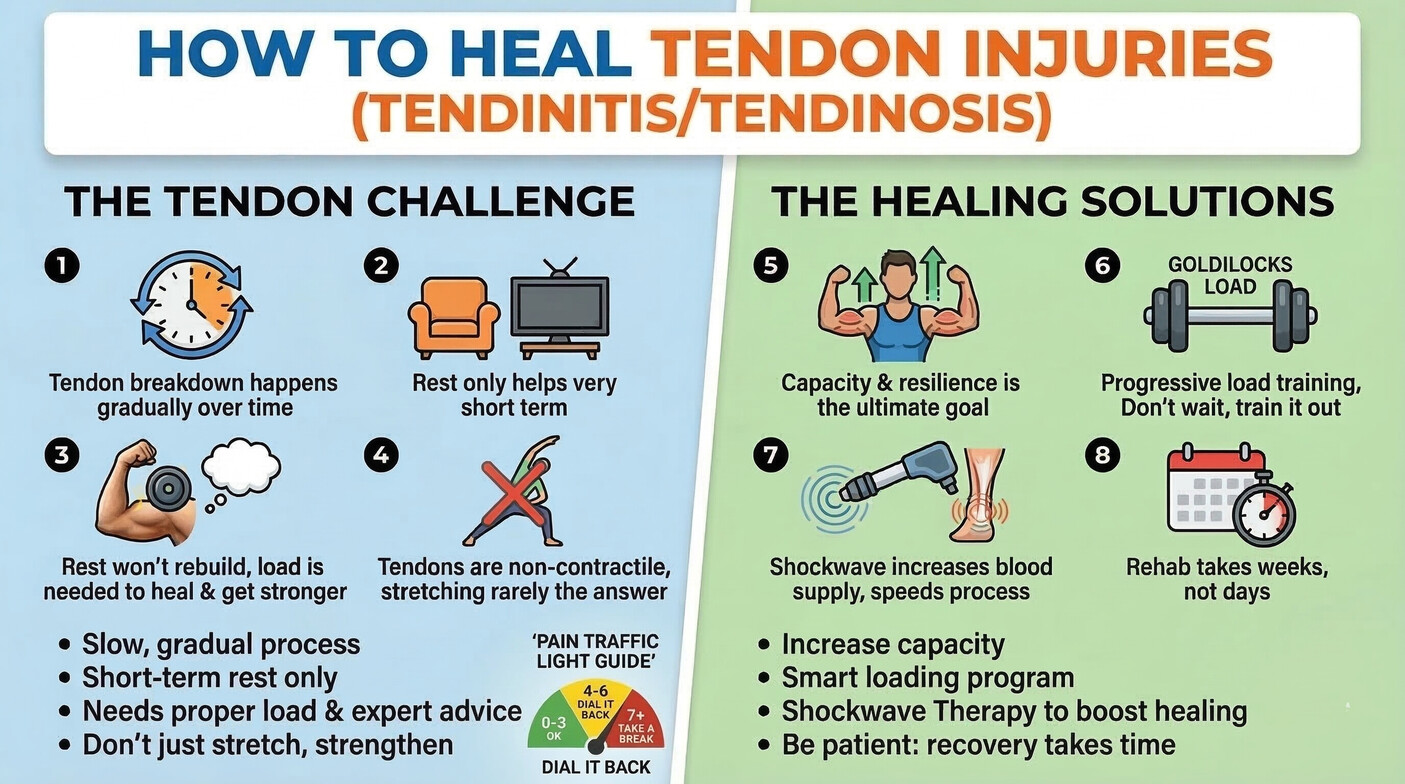
Don’t Wait It Out, Train It Out: The Truth About Healing Tendon Pain
If you’ve been dealing with a nagging ache in your Achilles, elbow, shoulder or patellar tendon, you’ve likely been told to "just rest it." But months later, the pain is still there. Why?
Because tendons are unique. They don't behave like muscles, and healing them requires a shift in how we think about recovery.
Tendonitis vs. Tendonosis: What’s the Difference?
While people use these terms interchangeably, they are technically different:
Tendonitis: Acute inflammation. This is rare and usually only lasts a few days after an initial injury.
Tendonosis: This is what most chronic "tendonitis" actually is. It’s a breakdown of collagen fibers due to overuse. It isn't an inflammatory problem; it’s a structural one.
1. The "Slow Burn" Injury
Tendon injuries rarely happen because of one single movement. They happen gradually over time. Think of it like a rope fraying; by the time you feel the "fray," the process has been happening under the surface for a while.
2. The Myth of Rest
Here is the hard truth: Rest won’t rebuild your tendon. While rest only helps in the very short term to calm down irritability, it eventually makes the tendon weaker. Tendons need load to heal and get stronger. Without weight or tension, the tendon has no reason to reorganize its fibers.
3. Training Through the Pain: The Traffic Light System
Since we need to "load" the tendon to fix it, you shouldn't wait for zero pain to start moving. However, you need to know your limits. Use this scale to find your "Goldilocks" zone:
Green (0–3): You’re good to go. This level of discomfort is safe.
Yellow (4–6): Dial it back a bit. You’re pushing the limit.
Red (7+): Time to take a break or change the exercise.
Pro Tip: Expert advice can help you figure out exactly how much load is right for your specific stage of healing.
4. Why It Takes So Long
Patience is mandatory. Tendons have a poor blood supply compared to muscles, which is why they heal more slowly . While a muscle strain might feel better in a week, tendon rehab can take weeks or even months, not days.
5. Stop Stretching!
Since tendons are non-contractile, stretching is rarely the answer . In many cases, aggressive stretching actually adds "compressive load" to the tendon, making the pain worse. Instead of pulling it, we need to strengthen it.
The Secret Weapons: Shockwave & Progressive Loading
If tendons have poor blood supply and need load to heal, how do we speed up the process?
Shockwave Therapy
Shockwave helps increase blood supply, speeding the process . It uses acoustic waves to create "micro-trauma" in the area, which signals the body to send fresh blood and growth factors to a tissue that usually gets ignored. It’s essentially "restarting" the healing process in a chronic injury.
The Ultimate Goal: Resilience
We don't just want the pain to go away; we want to make sure it doesn't come back. Capacity and resilience is the goal. We want a tendon that can handle the "spring" of running, the weight of lifting, and the demands of your daily life.
Don't wait it out—train it out. By combining shockwave therapy to jumpstart healing with a smart loading program, you can move from "fragile" back to "forceful."
At Sun Chiropractic our providers are experts in the treatment and management of common tedndon disorders. Will are able to diagnose your tendon pain and we direct bill most private insurance providers.

.jpg)
.jpg)